“Imagine six people at one open-plan bench. Today they type quietly. Tomorrow all six speak to their screens, each in a different conversation, but not with one another. When every desk becomes a microphone, acoustic privacy is no longer an amenity. It becomes infrastructure.”
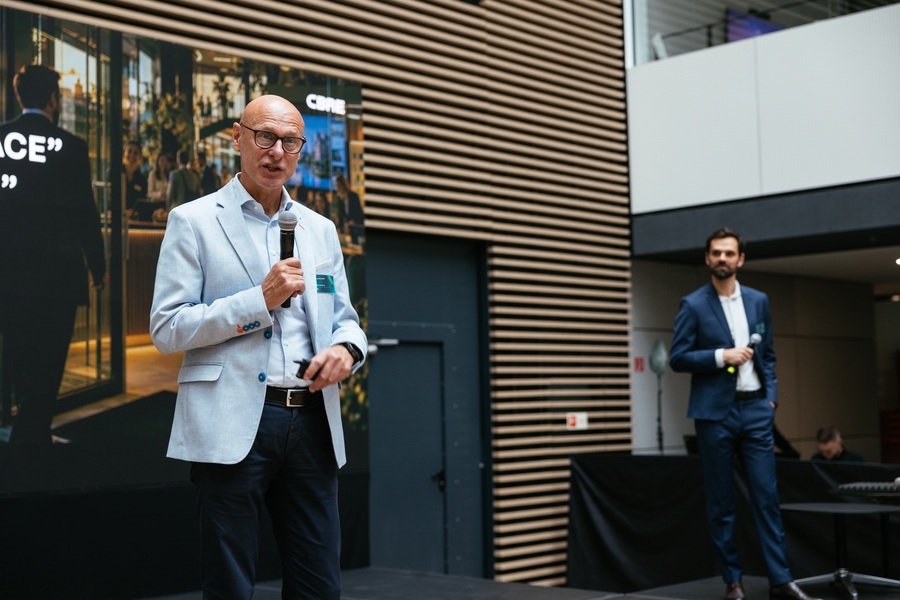
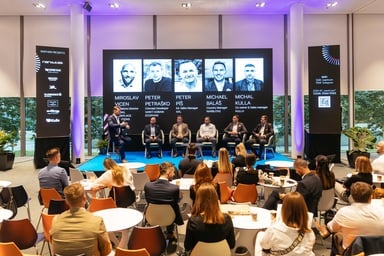
This is how Wouter Oosting of CBRE Amsterdam described the future of the office in his talk, which he delivered with Peter Gróf of CBRE Slovakia at the CBRE Office roka 2026 conference.
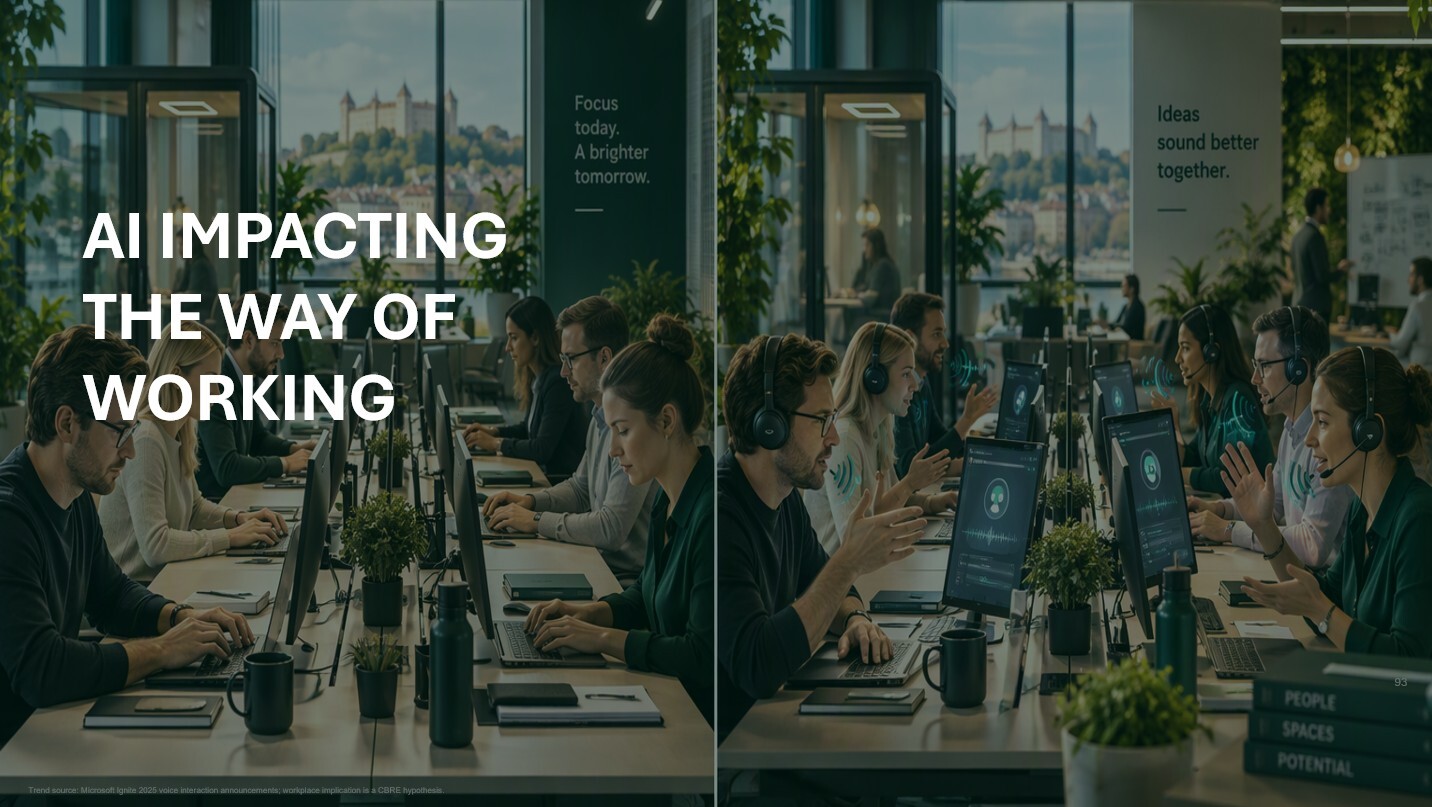
Their thesis is simple: artificial intelligence will definitely change the office. People will need fewer desks but a greater variety of spaces, and the office must earn the employee’s commute.
Fewer desks, not fewer square metres
According to CBRE Slovakia, net demand for office space will remain stable to growing. Fewer desks mean fewer square metres, but AI conversation pods need roughly three times more space per person. Companies are also willing to pay more per square metre if the quality of the environment improves.
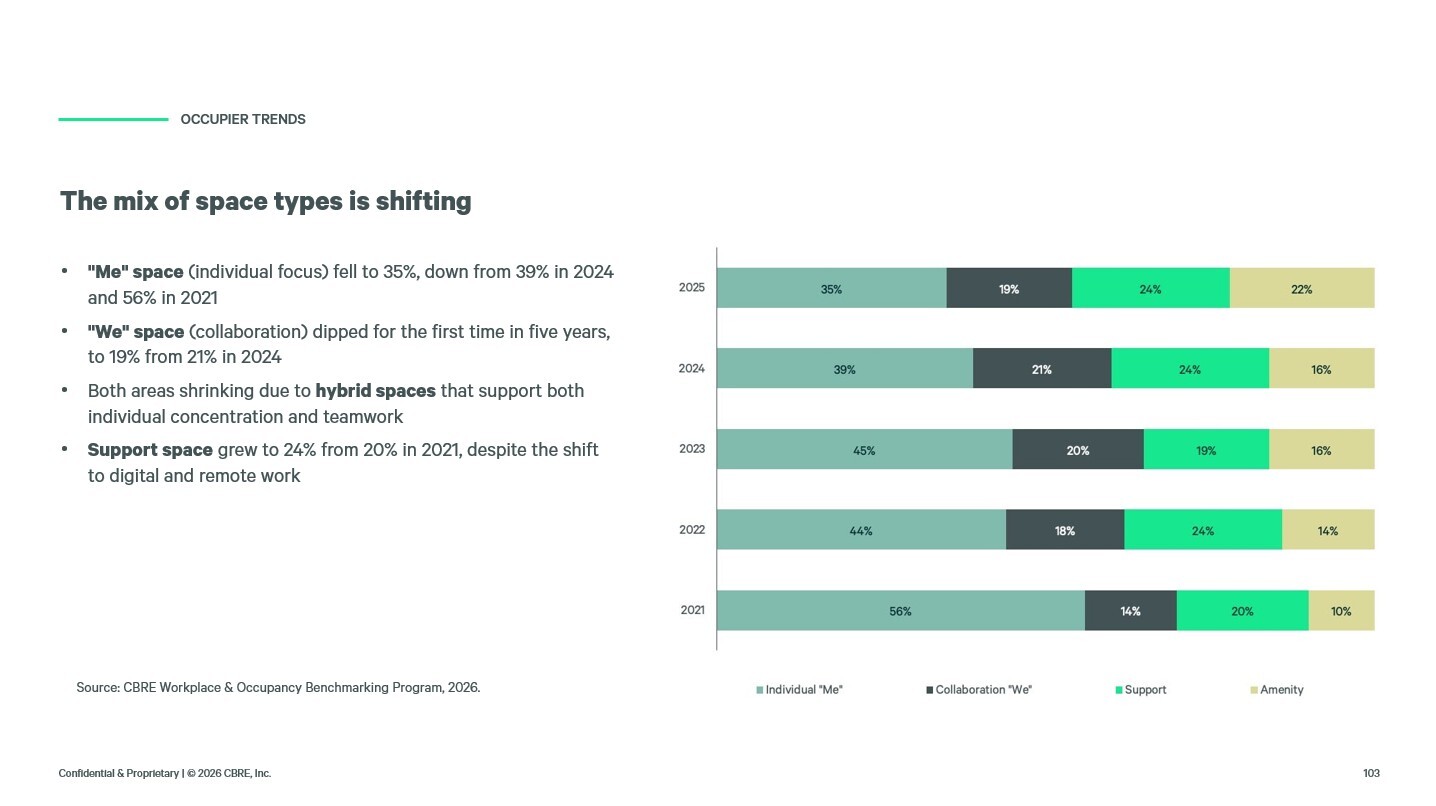
The mix of spaces is already changing. According to the CBRE Workplace & Occupancy Benchmarking Program 2026, the share of space for individual work (“me space”) fell to 35%, down from 39% in 2024 and 56% in 2021. Collaboration space (“we space”) fell for the first time in five years, to 19% from 21%. Both are giving way to hybrid spaces that support focused work and teamwork alike.
AI serves the individual, the office serves the team
Employees use AI mainly for administrative tasks. According to the CBRE Workplace & Occupancy Benchmarking Program 2026, 41% use it to generate text and ideas, 37% to take meeting minutes and 27% to summarise documents. Almost a third (31%) do not know how AI is used in their company, and only 12% use company tools.
Oosting pointed out that most AI tools serve individuals. The question is how to bring ideas together into a collective intelligence that makes sense for the whole organisation. That is why, according to the CBRE Occupier Panel 2026, as many as 80% of large companies and 68% of smaller ones expect the office to become more important as a place for creation and innovation. Most expect concentration and focus to stay the same.
Decisions remain with people. AI can prepare the numbers and the presentation, but a person judges whether they are right (so-called “human in the loop”). According to Peter Gróf, AI is not taking people’s jobs for now: in the office, they will work side by side.
Five new types of space in offices
CBRE proposes new types of space built around speech, judgement and creation:
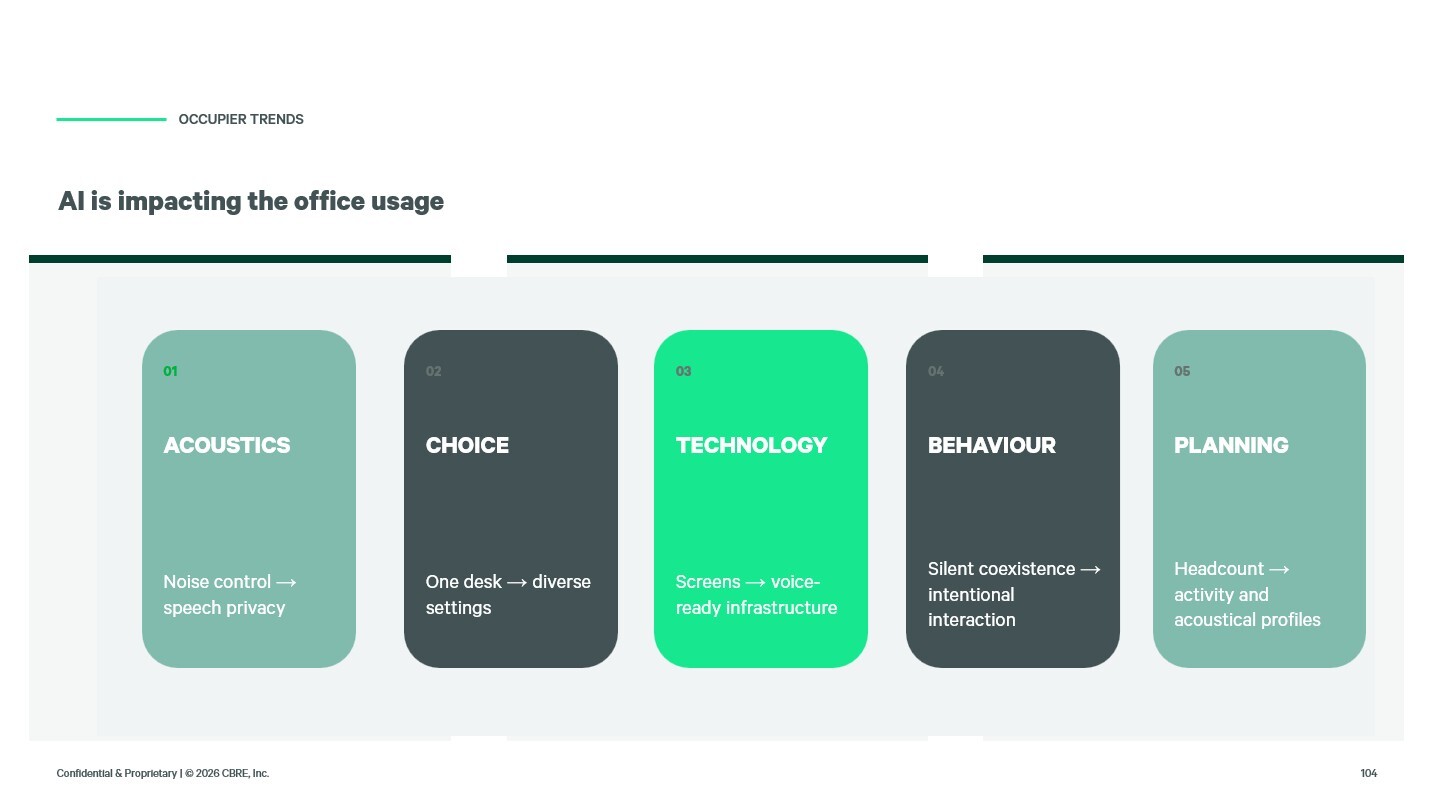
- AI conversation pod - voice work with AI without disturbing others.
- Quiet library - deep work and review of outputs.
- Project studio - collaboration between humans and AI.
- Decision room - scenarios and judgement.
- Social heart - a place for trust and belonging, where AI is not present.
Planning is therefore shifting from headcount to activities and acoustic profiles.
Wouter Oosting Executive Director Workplace Strategy & Innovation, CBRE Netherlands
“The biggest impact of AI is not what happens on the screen. It is what happens in the office.”
Would you like to know what spaces your office will need? Email Peter Gróf at Peter.Grof@cbre.com.
About the authors
Wouter Oosting is Executive Director, Workplace Strategies at CBRE Amsterdam and a member of the jury of the 10th edition of CBRE Office roka.
Peter Gróf is Director of the Workplace Design and Architecture division at CBRE Slovakia.